








&body=%0D%0AI would like more information about purchasing : 05-Pagan_ Sunrise Land_ Blatt18_Neg11_ 34x34_28x27.5(Large)%0D%0A%0D%0A------------%0D%0A%0D%0AImage: https://galleryluisotti.com/wordpress/wp-content/uploads/2026/09/05-Pagan_-Sunrise-Land_-Blatt18_Neg11_-3422x3422_2822x27.522Large-1.jpg%0D%0A%0D%0ACaption: Pagan Landscape #5 , 1976/1990
Vintage gelatin silver print
14.5 x 14.5 inches & 34 x 34 inches %0D%0A%0D%0AFrom page: https://galleryluisotti.com/exhibitions/views-of-pagan-1976-78/%0D%0A%0D%0A------------%0D%0A%0D%0APlease add your message and contact information below : %0D%0A%0D%0A%0D%0A%0D%0A%0D%0A%0D%0A)


&body=%0D%0AI would like more information about purchasing : 03-Pagan Landscape_32 x32_28x18(large)%0D%0A%0D%0A------------%0D%0A%0D%0AImage: https://galleryluisotti.com/wordpress/wp-content/uploads/2026/09/03-Pagan-Landscape_32-x32_2822x1822large.jpg%0D%0A%0D%0ACaption: Pagan Landscape #3 , 1976/1990
Vintage gelatin silver print
14.5 x 14.5 inches & 34 x 34 inches
%0D%0A%0D%0AFrom page: https://galleryluisotti.com/exhibitions/views-of-pagan-1976-78/%0D%0A%0D%0A------------%0D%0A%0D%0APlease add your message and contact information below : %0D%0A%0D%0A%0D%0A%0D%0A%0D%0A%0D%0A)


&body=%0D%0AI would like more information about purchasing : 08-Pagan_ East Bank_Irrawaddy River_Blatt30_(1small)%0D%0A%0D%0A------------%0D%0A%0D%0AImage: https://galleryluisotti.com/wordpress/wp-content/uploads/2026/09/08-Pagan_-East-Bank_Irrawaddy-River_Blatt30_1small.jpg%0D%0A%0D%0ACaption: Pagan Landscape #8 , 1976/1990
Vintage gelatin silver print
14.5 x 14.5 inches%0D%0A%0D%0AFrom page: https://galleryluisotti.com/exhibitions/views-of-pagan-1976-78/%0D%0A%0D%0A------------%0D%0A%0D%0APlease add your message and contact information below : %0D%0A%0D%0A%0D%0A%0D%0A%0D%0A%0D%0A)
&body=%0D%0AI would like more information about purchasing : 09-Pagan_East Bank, Irrawaddy River_Blatt42(1 small)%0D%0A%0D%0A------------%0D%0A%0D%0AImage: https://galleryluisotti.com/wordpress/wp-content/uploads/2026/09/09-Pagan_East-Bank-Irrawaddy-River_Blatt421-small.jpg%0D%0A%0D%0ACaption: Pagan Landscape #9 , 1976/1990
Vintage gelatin silver print
14.5 x 14.5 inches%0D%0A%0D%0AFrom page: https://galleryluisotti.com/exhibitions/views-of-pagan-1976-78/%0D%0A%0D%0A------------%0D%0A%0D%0APlease add your message and contact information below : %0D%0A%0D%0A%0D%0A%0D%0A%0D%0A%0D%0A)
&body=%0D%0AI would like more information about purchasing : 07-Pagan Sunrise_(2 small)%0D%0A%0D%0A------------%0D%0A%0D%0AImage: https://galleryluisotti.com/wordpress/wp-content/uploads/2026/09/07-Pagan-Sunrise_2-small.jpg%0D%0A%0D%0ACaption: Pagan Landscape #7 , 1976/1990
Vintage gelatin silver print
14.5 x 14.5 inches%0D%0A%0D%0AFrom page: https://galleryluisotti.com/exhibitions/views-of-pagan-1976-78/%0D%0A%0D%0A------------%0D%0A%0D%0APlease add your message and contact information below : %0D%0A%0D%0A%0D%0A%0D%0A%0D%0A%0D%0A)
&body=%0D%0AI would like more information about purchasing : 10-Pagan Lands _Blatt18-Neg4 _(Rare_small)%0D%0A%0D%0A------------%0D%0A%0D%0AImage: https://galleryluisotti.com/wordpress/wp-content/uploads/2026/09/10-Pagan-Lands-_Blatt18-Neg4-_Rare_small.jpg%0D%0A%0D%0ACaption: Pagan Landscape #10 , 1976/1990
Vintage gelatin silver print
14.5 x 14.5 inches%0D%0A%0D%0AFrom page: https://galleryluisotti.com/exhibitions/views-of-pagan-1976-78/%0D%0A%0D%0A------------%0D%0A%0D%0APlease add your message and contact information below : %0D%0A%0D%0A%0D%0A%0D%0A%0D%0A%0D%0A)

&body=%0D%0AI would like more information about purchasing : 04-Pagan Lanscape_33.5x 34_28x ?(Large)%0D%0A%0D%0A------------%0D%0A%0D%0AImage: https://galleryluisotti.com/wordpress/wp-content/uploads/2026/09/04-Pagan-Lanscape_33.522x-3422_2822x-Large.jpg%0D%0A%0D%0ACaption: Pagan Landscape #4 , 1976/1990
Vintage gelatin silver print
14.5 x 14.5 inches & 34 x 34 inches %0D%0A%0D%0AFrom page: https://galleryluisotti.com/exhibitions/views-of-pagan-1976-78/%0D%0A%0D%0A------------%0D%0A%0D%0APlease add your message and contact information below : %0D%0A%0D%0A%0D%0A%0D%0A%0D%0A%0D%0A)

Views of Pagan, Burma, 1976/78
September 19 – October 31, 2026
Press Links:
English translation of Views of Pagan, Burma, 1978 by Ursula Schulz-Dornburg and Rudolf Knubel
Gallery Luisotti is thrilled to present the United States debut of Ursula Schulz-Dornburg’s photographs of the ancient city of Pagan, Burma, in her fourth solo exhibition at the gallery.
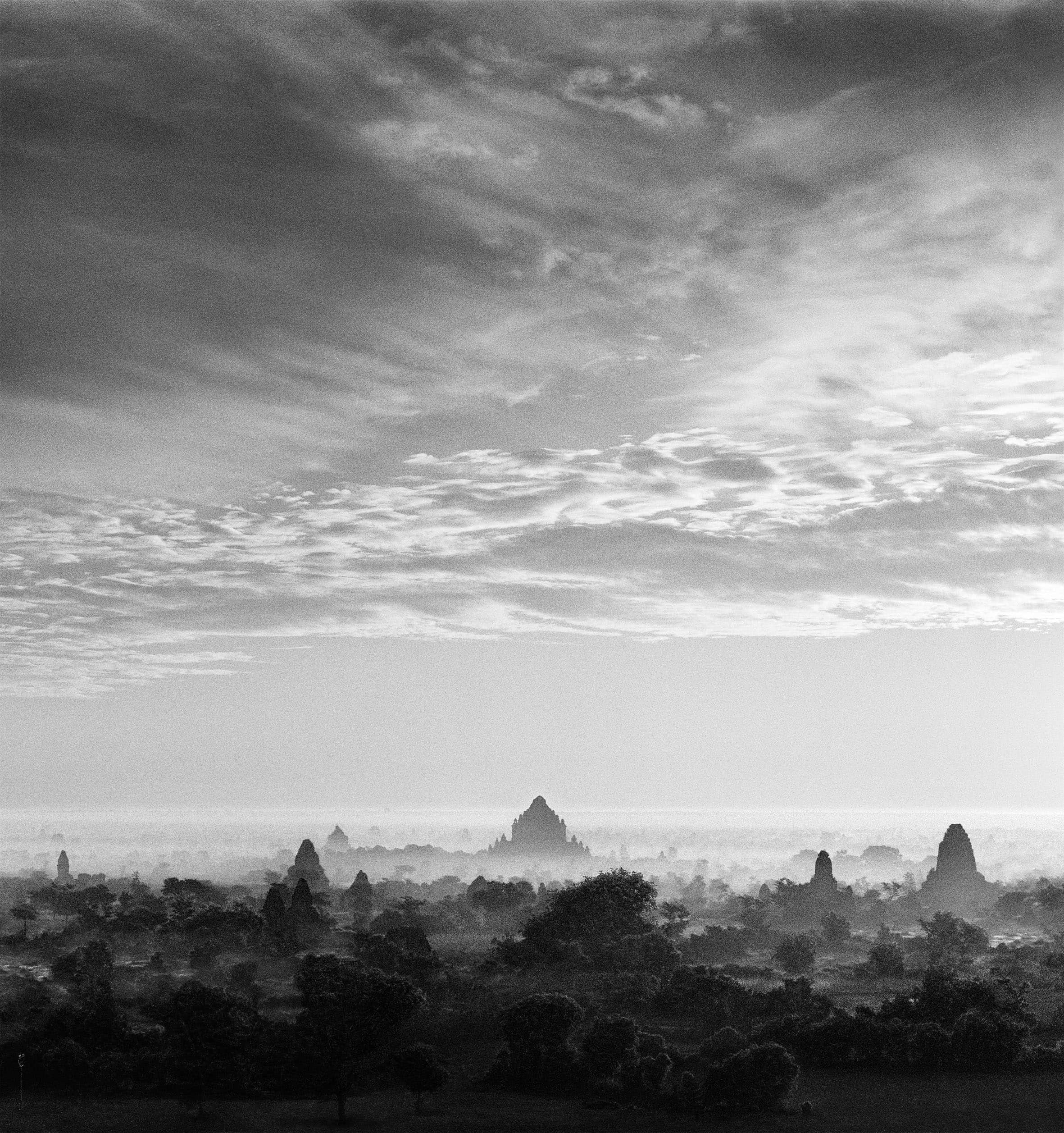
Pagan (present-day Bagan), where Theravada Buddhism was established as the state religion of Burma in the 11th century, is an extraordinary concentration of 11th- to 13th-century temples and pagodas spread across the Irrawaddy River valley, testifying to the remarkable power of Buddhist cosmology to shape an entire landscape. Taken at dawn, the photographs show the architecture at the edge of darkness or dissolving into pure light, like a spiritual awakening. The work was exhibited in Europe in 1978, 1998, and 2008 and has never before been shown in the United States.
Burma had been under military dictatorship since 1962, which made it difficult for Schulz-Dornburg to obtain a visa for her first trip in 1976. To enter the country, she assumed the alias of a merchant, traveling with a family friend, Rudolf Knubel. With few accommodations available, she stayed with a peasant family near Pagan. The family’s son drove her to the temples in a donkey-drawn cart, always discreetly before dawn, since tourists were not permitted to visit them.
Of the more than 2,000 surviving temples in the region, Schulz-Dornburg focused on 14 prominent structures, tracing a circular path alongside the river. The landscape photographs record successive positions along that path: one photograph shows a temple in the distance; the next brings us to it.
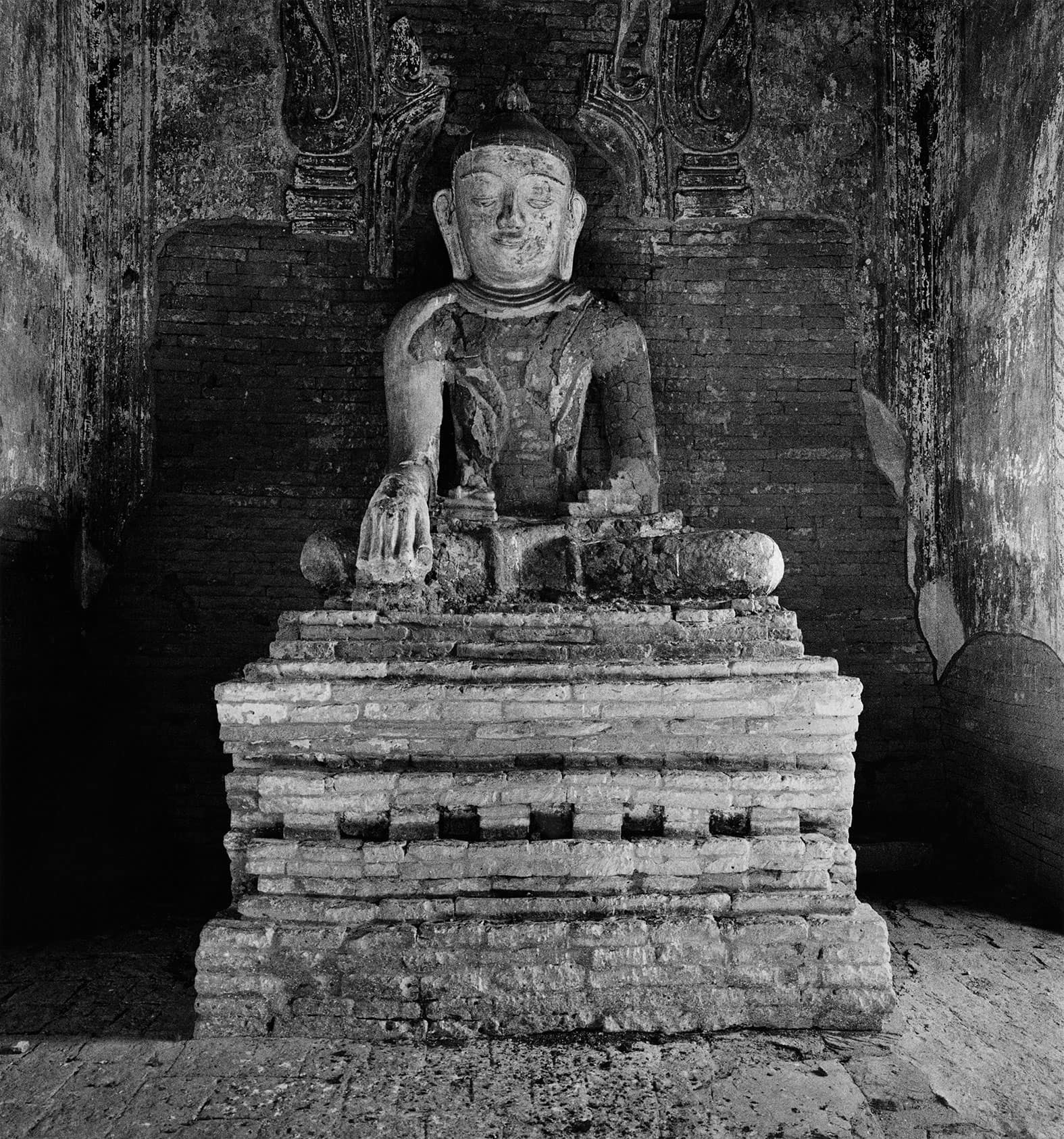
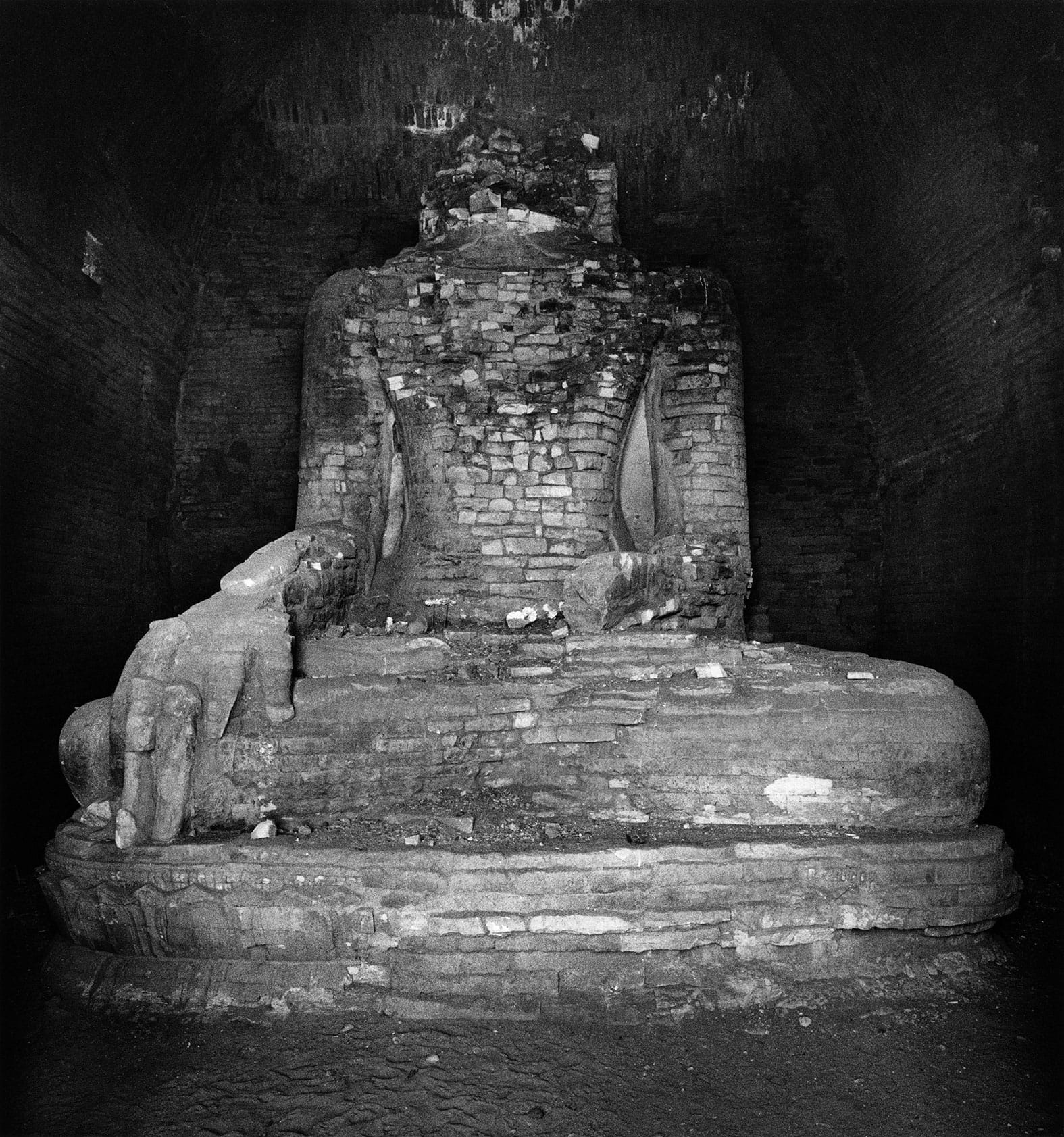
On her second trip to Burma, in 1978 she photographed the damaged brick-and-stucco statues of the Buddha inside each temple. The series shows how the great teacher becomes at once a devotional image and a casualty of economic misfortune. During construction, relics and precious stones were sealed into the sculptures at their chakra points. In leaner and less devout times the treasures were ripped from their bodies, by some to make ends meet and by others to stock collectors’ cabinets on foreign shores. Traditionally, Buddhists neither venerate nor visit damaged icons, and the figures have largely been left as they were found, which is what makes them seem like bearers of an ancient wisdom.
All the works in the exhibition are vintage gelatin silver prints. The landscapes are printed at scale, so that the grain of the enlarged negative reads as haze and the temples seem to hover between the furrowed fields and a sky bleached to white; in two views the sun is just breaking the horizon, and the monuments stand in silhouette beneath long banks of cloud. The Buddha photographs are square-format, frontal, and centered. Each figure sits on its stepped brick plinth, picked out of the darkness of the temple interior: heads and hands are missing, chests have been broken open, and the brick core shows through the stucco, while fragments of painted murals survive on the walls behind. One figure is glimpsed through a pointed arch, another through a lattice of bamboo scaffolding.
Pagan was built between the 11th and 13th centuries by King Anawrahta and his successors, who wished to improve their chances of reaching Nirvana and to spread the teachings of the Buddha. Like a mandala, the architectural landscape was ordered according to a cosmological system that has since been lost. In the centuries since, the site has been subject to numerous earthquakes and shifting political terrain; after a period of contentious relations between the Burmese government and UNESCO, it was inscribed on the World Heritage List in 2019.
Over the last millennium, Pagan has worn many guises and been restored to differing political ends. Its remains are a powerful reminder of the Buddhist philosophy of impermanence: that all empires must fall. Yet they also show how spiritual wisdom endures in the landscape, where it can be reactivated and survive limitless recontextualization.
Ursula Schulz-Dornburg (b. 1938, Berlin; lives and works in Düsseldorf) is a conceptual photographer of landscapes and of the structures left behind by bygone civilizations; her recent exhibitions have turned toward the heavens and what lies beyond life. Her work was the subject of the retrospective The Land In-Between at the Städel Museum, Frankfurt, in 2018, and is held in collections including Tate, London, and the Museum of Modern Art, New York. Her archive was acquired by the Getty Research Institute in 2022, and in 2025 she was awarded the Bernd and Hilla Becher Prize of the City of Düsseldorf.